Advanced PUR Adhesive Dispensing Solution for Automotive Lighting Manufacturing
In the automotive industry, lighting systems are no longer simple illumination components. Modern headlights and rear lamps integrate advanced optical structures, waterproof sealing technologies, electronic modules, and lightweight materials. As vehicle designs become more complex, automotive lighting manufacturers require adhesive solutions that provide:
High bonding strength;
Excellent sealing performance;
Precise glue application;
Stable production efficiency;
Compatibility with automated assembly lines.
However, many automotive lighting factories still face production challenges:
Manual glue application causes inconsistent adhesive paths;
Traditional dispensing equipment cannot handle complex 3D structures;
Low automation levels limit production capacity;
Excess glue increases material costs;
Poor sealing may lead to moisture intrusion and product failures.
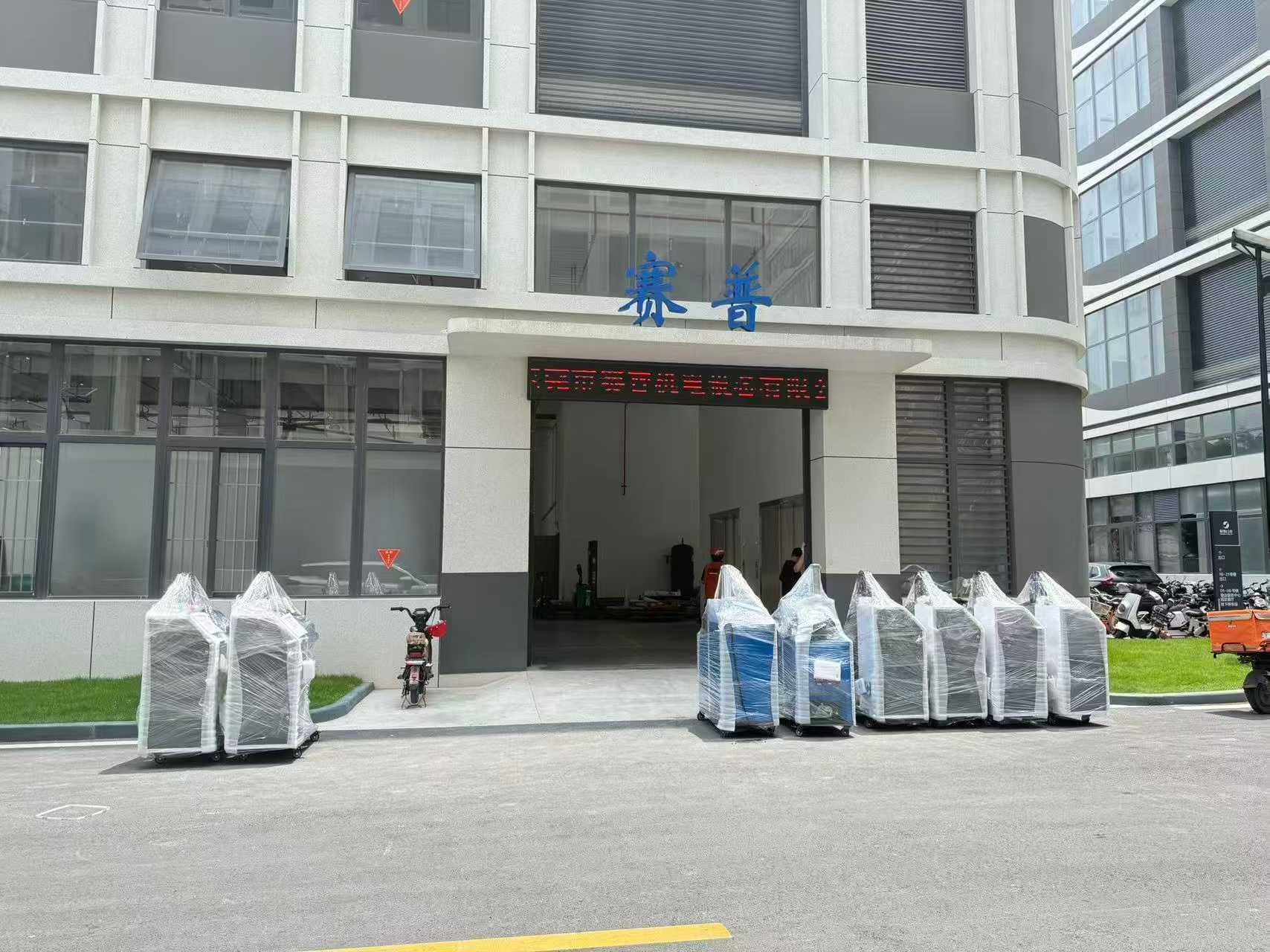
To solve these challenges, Saipu Electromechanical Device Co., Ltd introduces advanced 6-Axis Robot PUR Dispenser solutions, designed for automotive lighting manufacturers requiring high-precision, automated, and high-capacity adhesive application.
This article explains how robotic PUR dispensing technology improves automotive lighting production efficiency and why more manufacturers are upgrading their adhesive systems.
1. Product Definition: What Is a 6-Axis Robot PUR Dispenser?
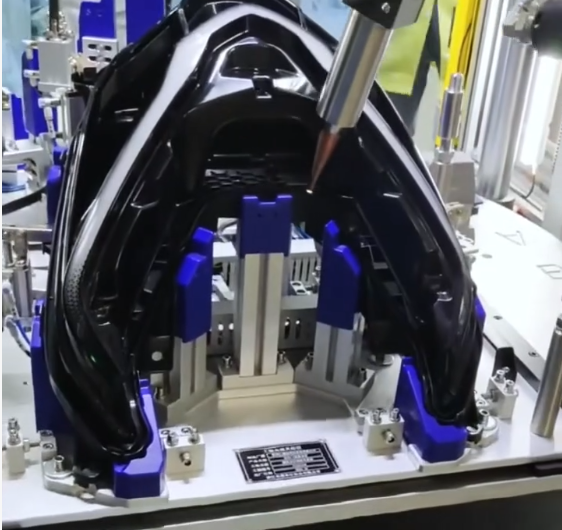
A 6-axis robot PUR dispenser is an automated adhesive application system that combines robotic motion control technology with a PUR hot melt adhesive dispensing system.
Unlike traditional manual glue guns or fixed dispensing equipment, a 6-axis robot can move flexibly in multiple directions, allowing precise adhesive application on complex automotive components.
The system typically includes:
Industrial 6-axis robot arm;
PUR hot melt adhesive melting unit;
Precision dispensing valve;
Heated hose system;
Intelligent control system;
Customized dispensing nozzle.
The main purpose is to achieve:
Accurate glue path control;
Consistent adhesive volume;
High-speed continuous production;
Reduced dependence on manual operation.
For automotive lighting manufacturers, the equipment is especially suitable for applications requiring waterproof sealing and structural bonding.
2. Why Automotive Lighting Production Needs Advanced PUR Dispensing Technology?
Automotive lamps must withstand harsh operating environments, including:
The adhesive system plays a critical role in protecting internal components.
Traditional manual adhesive application often creates problems:
2.1 Uneven Glue Lines Affect Sealing Performance
Headlight and taillight assemblies usually require continuous adhesive sealing.
If glue thickness varies, it may cause:
A robotic dispensing system ensures consistent adhesive paths and improves sealing reliability.
2.2 Complex Lamp Structures Require Flexible Movement
Modern automotive lamps include:
Fixed dispensing equipment may struggle with complex geometries.
The 6-axis robot provides flexible movement similar to a human arm but with higher repeatability.
2.3 High Production Volume Requires Automation
Automotive suppliers usually operate large-scale production lines.
Manual dispensing creates:
Automation allows manufacturers to maintain stable output while improving product consistency.
3. Application Scenarios of Saipu 6-Axis Robot PUR Dispenser in Auto Lighting
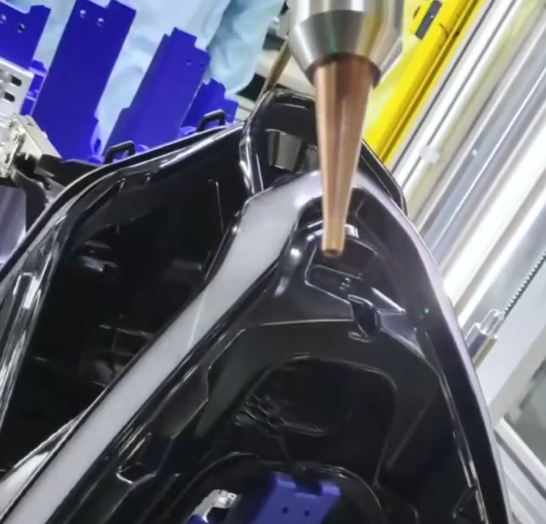
The Saipu 6-Axis Robot PUR Dispenser is designed for various automotive lighting applications.
3.1 Headlight Housing Sealing
Headlights require excellent waterproof performance.
The PUR dispensing system applies adhesive precisely around the lamp housing edge.
Benefits:
Continuous sealing line;
Strong bonding strength;
Reduced leakage risk;
Improved durability.
Typical applications:
3.2 Rear Lamp Assembly
Rear lamps contain multiple plastic components requiring reliable bonding.
The robot dispensing system supports:
Lens bonding;
Housing sealing;
Component fixing.
Compared with manual application, automated dispensing can improve adhesive consistency by more than 30% in mass production environments.
3.3 Electronic Module Bonding
Modern lighting systems integrate:
Sensors;
Control modules;
LED drivers.
PUR adhesive provides:
3.4 New Energy Vehicle Lighting Systems
With the rapid growth of electric vehicles, automotive lighting designs are becoming increasingly intelligent.
Applications include:
Smart headlights;
Decorative lighting;
Integrated lamp modules.
These products require higher precision adhesive solutions, making robotic PUR dispensing systems increasingly important.
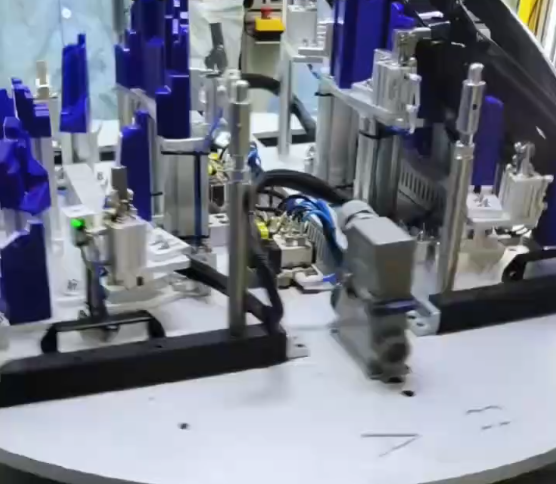
4. Key Technical Advantages of Saipu 6-Axis Robot PUR Dispenser
As a professional adhesive equipment manufacturer, Saipu Electromechanical Device Co., Ltd focuses on developing practical automation solutions for industrial customers.
4.1 High-Precision 6-Axis Motion Control
The robot arm provides multi-directional movement, allowing it to follow complicated adhesive paths.
Technical advantages:
| Item | Performance |
|---|
| Robot movement | 6-axis flexible control |
| Application type | PUR dispensing |
| Position accuracy | High repeatability |
| Application method | Continuous bead dispensing |
| Suitable materials | Plastic, metal, composite materials |
This enables manufacturers to achieve stable adhesive application for complex automotive components.
4.2 PUR Hot Melt Adhesive Technology
PUR adhesive combines the advantages of hot melt technology and reactive bonding.
Advantages:
Compared with traditional adhesives, PUR hot melt adhesive is better suited for automotive applications requiring long-term reliability.
4.3 Reduced Adhesive Waste
Precision dispensing controls adhesive volume accurately.
Production benefits:
| Production Factor | Traditional Manual Gluing | Saipu Robot PUR Dispensing |
|---|
| Glue control | Depends on operator | Automatic control |
| Material waste | Higher | Reduced |
| Quality consistency | Variable | Stable |
| Labor requirement | More | Less |
For large-scale automotive production, reducing adhesive waste can create significant annual savings.
4.4 Integration With Automated Production Lines
The system can be integrated with:
This helps manufacturers build smarter automotive component factories.
5. Technical Parameters Reference
| Parameter | Specification |
|---|
| Equipment Type | 6-Axis Robot PUR Dispenser |
| Adhesive Type | PUR Hot Melt Adhesive |
| Application Method | Automatic dispensing |
| Control Mode | Robot programming control |
| Production Mode | Continuous automation |
| Application Fields | Automotive lighting, electronics, assembly |
| Glue Output | Adjustable according to production requirements |
| Nozzle Type | Customized precision nozzle |
Parameters can be customized according to customer production requirements.
6. Purchasing Guide: How to Choose the Right PUR Dispensing Equipment?
Before investing in automated adhesive equipment, automotive manufacturers should consider several factors.
6.1 Production Requirements
Questions to evaluate:
What is the daily production volume?
Is the line fully automatic?
What is the required dispensing speed?
High-volume production usually requires robotic automation.
6.2 Adhesive Compatibility
Different PUR adhesives have different:
Professional equipment suppliers should evaluate adhesive properties before recommending solutions.
6.3 Dispensing Accuracy
For automotive lighting applications, customers should focus on:
Glue path accuracy;
Repeatability;
Nozzle performance;
Temperature stability.
Small dispensing errors may affect final sealing performance.
7. FAQ About 6-Axis Robot PUR Dispenser
Q1: Why use PUR adhesive for automotive lighting?
PUR adhesive provides strong bonding, waterproof performance, and excellent resistance against temperature changes, making it suitable for automotive environments.
Q2: Can the robot dispenser handle complex lamp shapes?
Yes. The 6-axis robot design allows flexible movement around curved and irregular surfaces.
Q3: Does robotic dispensing reduce production costs?
Yes. Automation reduces labor dependency, improves material utilization, and lowers defect rates.
Q4: Can Saipu customize dispensing solutions?
Yes. Saipu Electromechanical Device Co., Ltd provides customized adhesive application solutions based on different production requirements.
8. Why Choose Saipu Electromechanical Device Co., Ltd?
Choosing adhesive equipment is not only about purchasing a machine. It is about selecting a long-term technology partner.
Saipu Electromechanical Device Co., Ltd specializes in:
Hot melt adhesive equipment development;
PUR adhesive dispensing solutions;
Industrial glue application systems;
Customized automation solutions.
Our products are widely used in:
Automotive industry;
Packaging industry;
Furniture manufacturing;
Electronics industry;
Hygiene products;
Filtration industry.
Our advantages include:
Professional Technical Team
Experienced engineers provide:
Equipment selection;
Application testing;
Technical support.
Industry-Oriented Solutions
We focus on solving real production problems:
Uneven gluing;
Low efficiency;
Adhesive waste;
Quality instability.
Complete Service System
From initial consultation to after-sales support, Saipu provides reliable cooperation throughout the equipment lifecycle.
9. Upgrade Your Automotive Lighting Production With Saipu
As automotive manufacturing moves toward intelligent production, automated adhesive dispensing technology has become an important factor affecting product quality and production efficiency.
The Saipu 6-Axis Robot PUR Dispenser helps manufacturers achieve:
✔ More accurate adhesive application
✔ Higher production efficiency
✔ Better waterproof sealing
✔ Lower adhesive waste
✔ Stable automated production
If your automotive lighting factory is searching for a reliable PUR adhesive dispensing solution, Saipu Electromechanical Device Co., Ltd is ready to provide professional technical support.
🔥 Need Hot Melt Adhesive Solutions?
🌐 Website:
https://www.saipu-adhesivemachine.com/
📧 Email:
yoko@dgsaipu.com
📱 WhatsApp:
+86 13922963090
Saipu Electromechanical Device Co., Ltd — Professional Hot Melt Adhesive Solutions For Global Manufacturing.