


What Causes Uneven Spraying & Over-Spray Defects? Hot Melt Glue Machine Delivers One-Stop Bonding Solutions
2026-09-02 10:41In industrial adhesive application, a few millimeters can make a big difference.
A spray pattern that is slightly too wide may contaminate the edge of a product. An unstable glue output may create weak bonding in one area and excessive adhesive in another. When these problems repeat hundreds or thousands of times per shift, the result is not simply an appearance issue—it can become a measurable production cost.
For manufacturers working with mattresses, automotive interiors, packaging, leather goods, footwear, composite materials, edge banding, profile wrapping, courier bags, handle bags, bookbinding and air filtration products, uneven spraying and over-spray are two common challenges that deserve more attention during equipment selection.
The problem is often misunderstood as an adhesive-quality issue.
In reality, spray defects can come from several interacting factors:
Adhesive viscosity + temperature + pressure + nozzle design + spray distance + gun movement + substrate characteristics + machine control.
This is why choosing a suitable hot melt adhesive spraying system is more complicated than simply selecting a machine with a larger melting capacity.
Saipu Electromechanical Device Co., Ltd specializes in the R&D, manufacturing, sales and after-sales service of hot melt adhesive spraying equipment. With applications covering multiple industrial sectors, Saipu provides integrated adhesive spraying solutions designed around the actual bonding process rather than a single machine specification.
So, what causes uneven spraying and over-spray—and how can manufacturers select the right equipment to solve these problems?
1. The User Problem: Why Does Hot Melt Spraying Become Uneven?
Imagine a production line running at a stable speed.
At the beginning of the shift, the spray pattern looks acceptable.
After several hours, however, operators notice:
One side receives more adhesive than the other.
Spray width becomes inconsistent.
Adhesive reaches areas outside the bonding zone.
Glue accumulates around the nozzle.
Some products require manual touch-up.
Adhesive consumption gradually increases.
Operators frequently adjust pressure or temperature.
This is where production managers need to look beyond the spray gun itself.
1.1 Unstable Adhesive Temperature
Hot melt adhesive must be processed within an appropriate temperature range specified by the adhesive supplier.
If the temperature is too low, viscosity may increase and the adhesive may not atomize or distribute as intended.
If the temperature is too high or the adhesive remains heated for too long, the material can experience unnecessary thermal exposure.
Therefore, temperature stability is not simply a “heating” issue.
It directly influences the consistency of the application process.
1.2 Incorrect Spray Pressure
Spray pressure affects the way adhesive exits the nozzle.
If pressure is too low, the spray pattern may become incomplete or irregular.
If pressure is too high, the adhesive can travel beyond the intended bonding area, increasing over-spray.
A professional adhesive system should therefore provide controllable and repeatable pressure conditions rather than forcing operators to make frequent manual adjustments.
1.3 Nozzle Selection Does Matter
There is no universal nozzle for every application.
A mattress manufacturer may require a different spray pattern from a manufacturer bonding automotive interior fabrics.
Packaging applications may require narrow lines, while composite lamination may require broader coverage.
The nozzle should therefore be selected according to:
Adhesive type
Viscosity
Required coating width
Spray distance
Substrate
Production speed
Required adhesive weight
A mismatch between nozzle and application can create over-spray even when the machine itself is functioning correctly.
2. Product Selection: What Should a Factory Look for in a Hot Melt Glue Machine?
When factories purchase a hot melt adhesive system, the most common mistake is to compare machines only by melting capacity.
For example:
“Machine A has a larger tank than Machine B, so Machine A must be better.”
Not necessarily.
A production-oriented evaluation should examine the complete adhesive path:
Melting → Heating → Pumping → Pressure → Heated Hose → Spray Gun → Nozzle → Substrate
Each component can influence the final spray pattern.
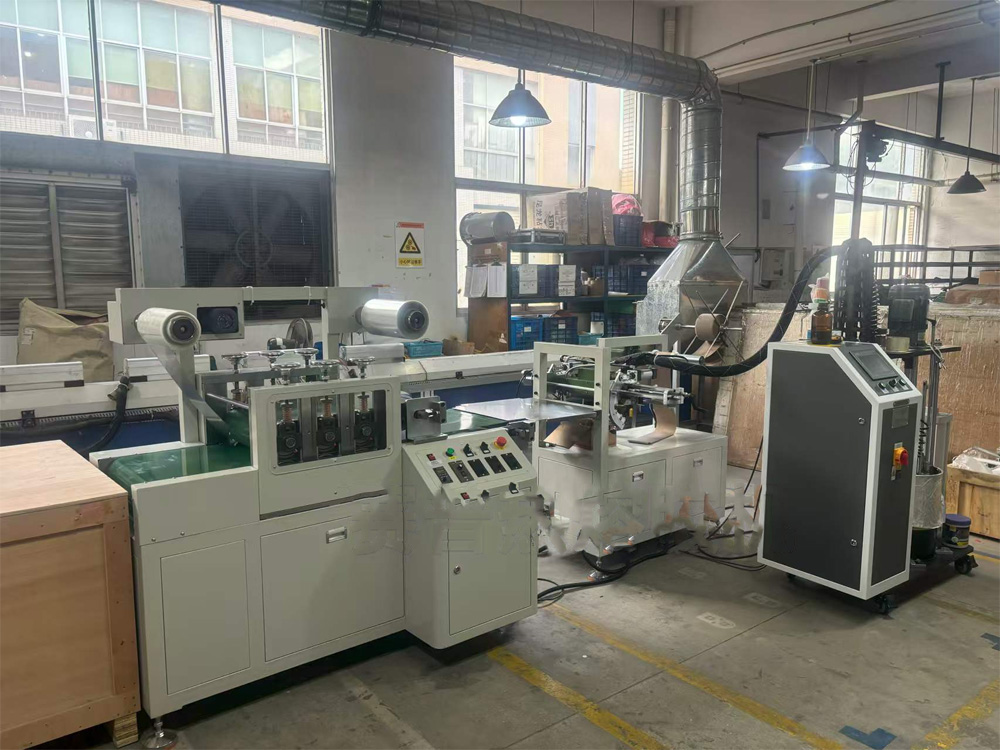
A suitable Hot Melt Glue Machine should therefore provide stable adhesive heating, consistent delivery and controllable application parameters.
More importantly, it should be matched to the customer's production process.
3. How Does a Complete Hot Melt Adhesive System Control Spray Quality?
A well-designed system should allow production engineers to establish repeatable process conditions.
The key variables normally include:
| Parameter | Production Impact | What Buyers Should Evaluate |
|---|---|---|
| Adhesive temperature | Influences viscosity and flow | Stable temperature control |
| Pump output | Determines adhesive supply | Output stability |
| Pressure | Influences spray pattern | Adjustable pressure |
| Nozzle | Determines spray width/pattern | Application-specific selection |
| Spray distance | Changes coverage | Repeatable gun positioning |
| Line speed | Influences adhesive distribution | Match machine to production speed |
| Adhesive viscosity | Affects atomization/flow | Match equipment to adhesive |
| Hose heating | Prevents viscosity changes in delivery | Independent temperature monitoring |
| Filter condition | Influences flow stability | Easy inspection and maintenance |
| Gun control | Determines opening/closing behavior | Fast and repeatable response |
The exact operating values should always be confirmed through adhesive technical data and production trials.
This is particularly important because there is no universal “best temperature,” “best pressure” or “best spray distance” for every hot melt adhesive.
4. Application Scenarios: One Equipment Platform, Multiple Bonding Processes
One reason industrial buyers increasingly consider integrated hot melt systems is the diversity of modern production.
The same manufacturer may produce several product categories, each requiring a different adhesive application pattern.
Mattress Manufacturing
Mattress production can involve bonding foam, fabric and other materials.
A spray system may need to cover relatively large areas while maintaining an even adhesive distribution.
If the spray pattern is too wide, adhesive can reach areas that do not require bonding.
If the pattern is too narrow, bonding coverage may become insufficient.
The equipment should therefore allow the spray width and application process to be matched to the mattress structure and production speed.
Automotive Interior
Automotive interior components often involve fabrics, foam, composite substrates and decorative materials.
Applications can include:
Headliners
Door panels
Trim materials
Acoustic components
Interior fabrics
For these applications, spray consistency is important because excessive adhesive can affect appearance, weight and material handling.
A properly configured hot melt system can help manufacturers establish a more repeatable application process.
Packaging
Packaging production often emphasizes speed.
Cartons, bags, handles and laminated packaging materials may require rapid adhesive application.
A stable spray pattern helps reduce:
Adhesive contamination
Manual rework
Excessive adhesive consumption
Unnecessary cleaning
For high-speed packaging lines, equipment response and synchronization with the production line become especially important.
Leather Goods and Footwear
Leather and footwear manufacturing may involve irregular surfaces, narrow bonding zones and different material combinations.
The spray system may therefore require more precise application control.
A wider spray pattern is not necessarily better.
In many cases, the goal is:
Put the right amount of adhesive in the right place.
That principle is at the heart of efficient hot melt adhesive application.
Air Filter Manufacturing
Filter products can contain large bonding areas as well as narrow sealing zones.
The adhesive system needs to provide stable delivery without excessive over-spray that could interfere with filtration media.
This is another example of why application-specific nozzle selection and process adjustment are essential.
5. What Causes Over-Spray?
Over-spray is often the visible result of several process variables being out of balance.
Common causes include:
Excessive Pressure
Too much pressure can push adhesive beyond the target area.
Incorrect Nozzle
A nozzle with an unsuitable spray angle or output characteristics can create excessive coverage.
Excessive Spray Distance
A larger distance between the gun and substrate can allow adhesive to spread outside the intended area.
Excessive Adhesive Output
If the application rate is higher than the substrate requires, excess adhesive accumulates.
Incorrect Synchronization
When the spray gun and production line are not properly synchronized, the adhesive can be applied before or after the intended bonding zone.
Unstable Adhesive Temperature
Changes in viscosity can alter the spray pattern.
This is why simply reducing pressure is not always the correct solution.
A process engineer should identify the actual cause before changing parameters.
6. How Can Manufacturers Reduce Adhesive Waste?
Reducing adhesive consumption does not necessarily mean reducing the adhesive layer as much as possible.
The objective is to reach the required bonding performance with a controlled and repeatable adhesive application.
A useful optimization sequence is:
Step 1 — Confirm adhesive specifications
Check viscosity, recommended temperature and application method.
Step 2 — Stabilize temperature
Ensure the melter and heated hose maintain appropriate processing conditions.
Step 3 — Set appropriate pressure
Adjust pressure according to the adhesive and nozzle.
Step 4 — Optimize nozzle selection
Choose the spray pattern according to the actual bonding area.
Step 5 — Control spray distance
Maintain a consistent distance during manual or automated application.
Step 6 — Synchronize production speed
Match adhesive output to line speed.
Step 7 — Measure adhesive consumption
Record adhesive consumption per product or per production batch.
This final step is particularly important.
Without measurement, a factory may assume that the new process is saving adhesive without knowing whether it actually does.
7. Technical Data Should Be Used for Process Decisions
For industrial procurement, equipment specifications should be connected to measurable production indicators.
A practical factory evaluation can include:
| KPI | Measurement Method |
|---|---|
| Adhesive consumption | kg/product or kg/1,000 products |
| Spray width | mm |
| Application temperature | °C |
| Adhesive pressure | bar |
| Line speed | m/min or pcs/min |
| Defect rate | % |
| Rework rate | % |
| Nozzle cleaning frequency | times/shift |
| Unplanned downtime | min/shift |
| Adhesive waste | kg/week or kg/month |
These indicators allow manufacturers to compare the old and new processes objectively.
For example, if a factory currently consumes 12 kg of adhesive per 1,000 products, the purchasing team can establish this as a baseline.
After equipment optimization, the factory can measure the new consumption under comparable production conditions.
That is far more meaningful than claiming a generic percentage of adhesive savings.
8. Procurement Decision: What Should Buyers Ask Suppliers?
Before ordering a hot melt spraying system, procurement teams should provide the supplier with as much application information as possible.
About the Adhesive
Adhesive brand
Adhesive model
Viscosity
Recommended processing temperature
Packaging format
Application method
About the Product
Product dimensions
Substrate type
Bonding area
Required adhesive pattern
Required adhesive weight
About Production
Production speed
Daily working hours
Number of shifts
Current adhesive consumption
Current defect rate
About Automation
Manual or automatic spraying
Number of guns
PLC integration
Production-line synchronization
Robot integration requirements
This information allows the equipment supplier to recommend a configuration based on actual process requirements.
9. Why Choose Saipu for One-Stop Hot Melt Adhesive Solutions?
Saipu Electromechanical Device Co., Ltd focuses on hot melt adhesive spraying machinery and provides equipment solutions for a wide range of industrial applications.
Its application coverage includes:
Mattress bonding
Automotive interior bonding
Packaging
Leather goods
Footwear
Composite materials
Edge banding
Profile wrapping
Courier bags
Handle bags
Bookbinding
Air filtration
This cross-industry application experience matters because each application has a different definition of “good spraying.”
For a mattress factory, large-area coverage may be important.
For an automotive interior supplier, controlled distribution and appearance may receive more attention.
For packaging, production speed and repeatability may dominate.
For leather goods, application precision may be more important.
Therefore, Saipu's approach is to evaluate the adhesive + material + application pattern + production speed + equipment configuration as a complete system.
10. From Equipment Selection to Factory Commissioning
A reliable supplier should not disappear after delivering the machine.
A practical hot melt adhesive project can involve several stages.
① Application Assessment
Understand the customer's product, adhesive and production target.
② Equipment Configuration
Select the appropriate melting capacity, pump, hose, spray gun and nozzle.
③ Process Matching
Adjust temperature, pressure, spray pattern and application distance.
④ Machine Testing
Verify adhesive delivery and spray performance before production.
⑤ Production Commissioning
Fine-tune the equipment according to the customer's actual line speed and substrate.
⑥ After-Sales Support
Provide technical assistance for operation, maintenance and troubleshooting.
This process turns a machine purchase into an actual production solution.
11. FAQ
Why does my hot melt spray pattern become uneven?
Possible causes include unstable adhesive temperature, incorrect pressure, unsuitable nozzle selection, inconsistent spray distance, adhesive viscosity changes or poor synchronization with the production line.
How can I reduce hot melt adhesive over-spray?
Start by checking adhesive temperature, pressure, nozzle selection, spray distance and adhesive output. The correct solution depends on the specific adhesive and application.
Does a larger hot melt machine automatically improve spraying quality?
No. Melting capacity is only one factor. Pump stability, temperature control, pressure regulation, heated hoses and spray gun/nozzle configuration can be equally important.
Can one hot melt system serve different industries?
Potentially yes, provided the machine configuration is matched to the adhesive and application requirements. Different applications may require different guns, nozzles and process parameters.
How should I choose a spray nozzle?
The nozzle should be selected according to adhesive viscosity, spray width, substrate, line speed and required application pattern. A production trial is recommended before finalizing the configuration.
Can Saipu provide customized hot melt spraying solutions?
Yes. Customers can provide adhesive information, product details, application requirements and production-line parameters so that the equipment configuration can be evaluated accordingly.
12. Conclusion: Better Spraying Starts With Better Process Control
Uneven spraying and over-spray are rarely caused by one isolated factor.
They are usually the result of several variables working together:
Temperature + viscosity + pressure + nozzle + spray distance + output + line speed + substrate.
That is why manufacturers should avoid choosing equipment based solely on tank capacity or machine price.
A properly configured hot melt adhesive spraying system should provide stable adhesive delivery while giving production teams enough control to optimize the application process.
For manufacturers working with mattresses, automotive interiors, packaging, leather goods, footwear, composite materials, edge banding, wrapping, courier bags, handle bags, bookbinding and air filtration, the right equipment can become an important part of improving bonding consistency and controlling adhesive consumption.
Saipu Electromechanical Device Co., Ltd provides hot melt adhesive spraying equipment and application-oriented solutions designed around different industrial bonding requirements.
If your factory is experiencing uneven spray patterns, excessive adhesive consumption, frequent nozzle cleaning or over-spray defects, do not start by simply increasing or reducing pressure.
Start with the entire process.
Tell us your adhesive type, substrate, product, spray width, line speed and current production problem. Saipu can help you evaluate the appropriate hot melt adhesive spraying configuration and build a more stable bonding process.
Need a Hot Melt Adhesive Solution for Your Production Line?
Contact Saipu Electromechanical Device Co., Ltd. to discuss your application requirements and equipment configuration.
Website: https://www.saipu-adhesivemachine.com/
From adhesive supply to final spraying, the goal is simple: more adhesive where it is needed, less waste where it is not.